Bird Sort 2: Color Puzzle
- 4.4
- Rating
- 10.00M
- Installs
- Free
- Price
 Analysis by App-foxy
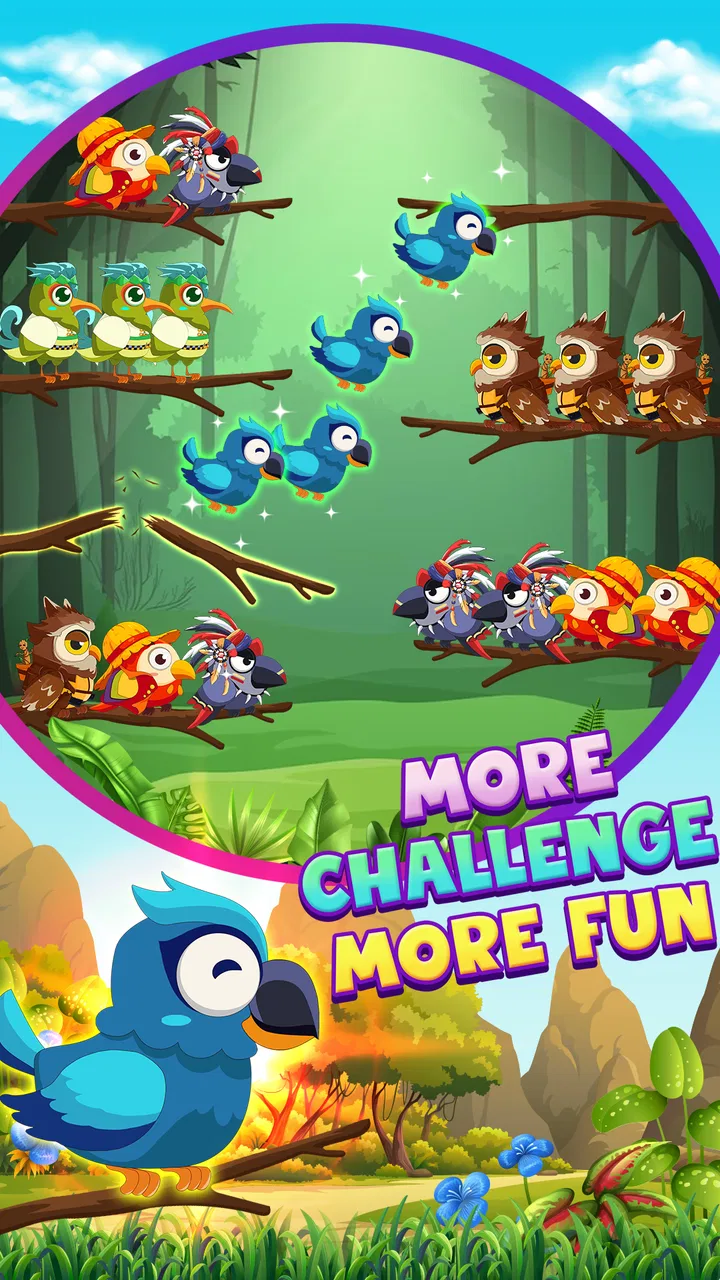
I approached Bird Sort 2: Color Puzzle expecting a familiar color-sorting game, but its bird theme gives the basic idea a more playful personality. The task is simple to understand: organize birds by color while thinking carefully about where each move leaves you. That easy entry is exactly why it works well for short breaks, yet the limited space and increasingly awkward arrangements can make a supposedly small puzzle surprisingly demanding.
This is a free puzzle game from FALCON GAME, rated Everyone, and it is available for devices running Android 7.1 or later. Its broad appeal is easy to see: the game has passed 10 million installs and holds a 4.4 average from roughly 83,000 ratings. Those numbers do not replace personal experience, but they fit what I found in practice: it is approachable within seconds, requires no tutorial-heavy commitment, and gives you a reason to try “one more level” when a solution is almost within reach.
How the everyday puzzle loop feels
My usual workflow begins with a quick scan rather than an immediate tap. I look for birds that can be moved without burying a useful color, then identify which containers are close to becoming complete. That first pause matters. In this kind of puzzle, the most obvious move is often not the best one, because placing a matching bird may close off the color underneath it or consume the only open space needed later.
You May Also Like

 Blood Strike: 2.5 Anniversary
Blood Strike’s Loadouts Turn Every Drop Into a Tactical Gamble
A close look at Blood Strike’s custom loadouts: how fast access to signature weapons reshapes its battle royale rhythm, rewards preparation, and narrows the gap between fights.

 Pandora - Music & Podcasts
Pandora’s Music Is Easy to Start, but Harder to Recover
Pandora’s strength is its low-effort path from a seed to a station. Its weak spot is how much confidence it asks you to place in connection, setup, and quiet recovery.

 8 Ball Pool
 Is Built on Rivalries, Rematches, and Routine
A close look at the rivalries, rematches, shared routines, and unanswered safety questions that turn a quick pool match into a persistent mobile community.

 Samsung Music
’s Quiet Strength Is Playing What You Already Own
Its reach comes less from spectacle than from dependable access to a personal library. That simplicity is both the app’s strongest retention engine and its ceiling.

 AccuWeather: Weather Radar
AccuWeather Review: A Quick, Clear Forecast for Everyday Decisions
For everyday plans, the best forecast is the one you can understand quickly. AccuWeather makes rain timing, radar, and local conditions easy to act on, with a few trade-offs.

 Hill Climb Racing
Why Hill Climb Racing Still Turns Crashes Into One More Run
A tiny car, a bumpy hill and one more upgrade: Hill Climb Racing keeps resurfacing because its simple chaos makes every near-miss feel personal.
More From Our News Desk



The controls are designed for direct play. I tap a bird grouping and choose where it should go, then watch the arrangement change. The rules are familiar enough that I can play without reading long instructions, but the simplicity should not be confused with mindless matching. A successful move usually does two jobs at once: it brings colors together and creates room for another sequence.
I find the game most enjoyable when I treat each level as a small planning exercise. Instead of chasing the first available match, I ask which color is currently blocking the most options. Moving that color may not produce an immediate payoff, but it can open a lane for several later moves. This habit is particularly useful when the board contains several partially formed groups and only a small amount of free space.
A realistic use case is a short wait at a station or a few quiet minutes before an appointment. I can start a level, make progress, and stop without needing a long uninterrupted session. The format also suits anyone who likes visual puzzles but does not want a complicated story, character system, or competitive schedule getting in the way.
That said, I would not choose it for someone looking for a deep logic game with many rule types. The central action remains color sorting, so players who need constant mechanical variety may eventually feel that the presentation changes more than the underlying activity. It is better understood as a focused casual puzzle than as a broad strategy game.
The first habit that prevents avoidable mistakes
I recommend leaving a deliberate buffer whenever possible. A completely empty container feels useful, but using it too early can create a false sense of progress. If I fill every available space with partial color groups, I may have no safe place to temporarily move a bird that is blocking the real solution. Keeping one flexible space available is often more valuable than completing a group a few moves sooner.
Another useful habit is to separate “setup moves” from “finishing moves.” A setup move exposes a hidden color or clears a path; it may look inefficient because it does not complete anything. A finishing move consolidates a color into a clean group. Recognizing the difference helps me avoid judging every tap by its immediate result.
When I get stuck, I do not automatically restart. I first look for the move that creates the most visibility. Sometimes the board feels impossible simply because a useful bird is covered by an inconvenient layer. Reversing one earlier decision, when the game allows it through its available controls, can reveal whether the problem was a poor sequence or a genuinely tight position. This is a better use of time than repeating the same opening.
Settings and practical choices worth checking
Before settling into longer sessions, I check the available in-game options and the way the device behaves during play. The important point is not to assume that a setting will change the puzzle rules. Settings are most useful for making the experience comfortable: sound can be adjusted to suit a quiet room, and notification interruptions can be handled at the device level if I want a calmer session.
I also pay attention to how I use hints, undo-style assistance, or other recovery options when they are available in the current play experience. I prefer to reserve help for positions where I have tested the obvious alternatives rather than spending it on a move I could have solved by slowing down. That turns assistance into a genuine fallback instead of part of every routine solution.
Because the game is free to download, it is easy to begin without financial commitment. It does include optional in-app purchases ranging from $1.99 to $94.99 per item, so I would check purchase controls before handing the device to a child. The Everyone rating makes it suitable for a broad audience, but the presence of optional purchases is still a practical detail families should manage through their normal device settings.
The current version is 6.0.1, and I would keep the installation updated through the normal app store process rather than relying on an old copy. Updates can affect stability and compatibility, especially on older devices. Since the minimum operating system is Android 7.1, people using very old hardware should confirm that their device meets that requirement before planning around the game.
One setting-related choice is simply deciding when not to play. Bright colors and repeated sorting can be pleasant for a few minutes, but a long session after a tiring day may turn the game into automatic tapping. I get more from it when I use it as a focused break: a handful of levels, a pause after a difficult board, and a return only when I still feel curious about the solution.
How I use help without removing the puzzle
My preferred approach is to treat assistance as a diagnostic tool. If I use a hint, I study what it reveals instead of immediately following every suggested action. The valuable lesson is often structural: perhaps I missed a temporary holding space, or perhaps I was protecting a group that needed to be disturbed. Once I understand that pattern, I can solve similar positions independently.
This matters because the satisfaction of Bird Sort 2 comes from recognizing the board’s order, not merely reaching the end. Players who use every available aid at the first sign of difficulty may progress faster, but they can also lose the small strategic challenge that makes the game more than a visual matching exercise.
Faster patterns for experienced play
After spending time with the basic loop, I became quicker by sorting the board into priorities. First, I identify colors that are already close to completion. Next, I locate colors that appear in several places and therefore need careful coordination. Finally, I note the birds that are acting as blockers. This three-part scan is faster than examining every possible move with equal attention.
A strong opening often comes from exposing information rather than completing a color. If a move reveals what sits beneath a stack, it can be more valuable than a move that makes a neat but isolated group. I look for actions that reduce uncertainty. Once I know where the remaining colors are, the later decisions become less dependent on guesswork.
I also avoid moving a nearly complete group unless it serves a clear purpose. A tidy group can function as an anchor, helping me understand how much room remains. Breaking it apart may be necessary, but I want a reason: opening a blocked color, creating a temporary slot, or enabling a larger chain. Moving pieces simply because they can move usually makes the board harder to read.
One of the less obvious trade-offs is between local progress and board-wide flexibility. Completing one color feels rewarding, but if that completion occupies the only useful destination, it can prevent a more important rearrangement. In tight positions, I favor flexibility over appearance. A messy board with two open options is often healthier than a clean board with no room left.
For repeat play, I use a consistent opening checklist. I scan for the deepest blockers, count the genuinely usable spaces by sight, and choose one move that improves access to information. I do not try to memorize a fixed sequence because the value of a move depends on the arrangement in front of me. The repeatable habit is the scan itself, not a universal solution.
When restarting is smarter than forcing the board
Restarting can be the right choice when the early sequence has consumed the available flexibility. I usually recognize this when several colors are split across locations, every open space is occupied by an unfinished group, and my remaining moves only shuffle the same birds. Continuing may still work, but the cost in attention is no longer worth it.
On the other hand, I do not restart merely because the board looks untidy. Some of the best solutions begin with temporary disorder. If a move has opened a previously hidden color or created a route for a blocked group, I give that position a chance. The difference is whether the mess has a purpose. Productive disorder expands options; unproductive disorder only consumes them.
This is also where the game differs from a simple matching alternative. In a basic match-three title, I can often rely on immediate combinations and changing opportunities. Here, the important decision may be several moves ahead, and a move that looks inactive can determine whether the final colors fit. Players who enjoy planning will appreciate that restraint. Players who prefer constant visual rewards may find it slower.
Where the challenge reaches its limits
The game’s strongest quality is also its main limitation: it keeps returning to one recognizable puzzle structure. The bird presentation makes the sorting feel friendlier, but it does not transform the genre into something entirely new. After a long session, I can feel the repetition, especially if I am playing only for speed rather than trying to improve my decision-making.
There is also a mental cost to mistakes. A single careless placement can make the rest of a level much more constrained, and recovering may require patience rather than cleverness. That is not a flaw in the rules, but it means the game is not always relaxing in the same way as a purely casual matching app. If I want something I can play with almost no concentration, I choose a simpler alternative.
The optional purchase range is another consideration. Free access makes the game easy to try, but players who dislike any purchase prompts or who want a completely uninterrupted experience should review the store and device controls before committing to regular play. I would also be cautious about recommending unsupervised play to a child solely because the content rating is Everyone; purchase management is still the adult’s responsibility.
Compared with traditional tile-matching games, this one gives me less moment-to-moment randomness and more responsibility for arranging the board. Compared with a pure logic puzzle, it is more approachable and visually light, but it may not offer the same variety of rule systems or handcrafted deduction. That middle position is useful: it works for people who want a gentle entry into planning, not for players seeking a complex puzzle laboratory.
Performance expectations are straightforward on compatible devices, but older phones can make any touch-based puzzle less comfortable if taps do not register cleanly or the display feels cramped. I prefer playing when I can clearly distinguish the bird colors and container boundaries. That is not about chasing the largest screen; it is about avoiding accidental moves in a game where one misplaced tap can change the whole position.
Who should install it and who should skip it
I would recommend it to casual puzzle fans who like organizing visual groups, people who enjoy short sessions, and players who want a game that explains itself through interaction. It is also a good fit for someone moving from simple matching games toward more deliberate planning, because the rules are easy to grasp while the better solutions require restraint.
I would skip it if I need a story, a large collection of unrelated mini-games, or a puzzle system that constantly introduces new mechanics. I would also look elsewhere if I find sorting themes repetitive after a few sessions. The game is most convincing when its focused format is a benefit rather than a limitation.
For families, the Everyone rating is reassuring from a content perspective, and the low entry cost makes trying it simple. Still, I would configure purchase protections first and explain that optional items are not necessary for learning the basic play. For commuters or people who play during short breaks, the compact level structure is more relevant than any long-term progression promise: it is easy to pick up, pause, and return to.
My verdict after building a repeatable routine
Bird Sort 2: Color Puzzle works because it turns a very readable idea into a small test of sequencing. I enjoy it most when I stop treating each move as a quick match and start treating the board as a limited workspace. The practical difference comes from preserving room, exposing blocked colors, and refusing to complete a group just because it looks convenient.
FALCON GAME has made a free puzzle that is welcoming without being completely effortless. Its bird theme softens the presentation, while the sorting structure gives experienced players enough room to develop habits and improve. The game is not endlessly varied, and optional purchases may bother people who want a totally frictionless experience, but those are fair trade-offs for a focused casual title.
My final recommendation is simple: try it if you like visual organization with a little forward planning, and give yourself time to learn the value of setup moves. Keep one flexible space when you can, inspect the board before tapping, and use help as a lesson rather than an automatic shortcut. The best results come from protecting future options, not from making the board look tidy as quickly as possible.
With its free starting point, Everyone rating, and support for Android 7.1 or later, it is easy to test on a compatible phone. I would not call it the definitive puzzle game for every player, but for short, thoughtful sessions built around color organization, it earns a place among the more approachable choices in its category.
FAQs for Bird Sort 2: Color Puzzle
01What is Bird Sort 2: Color Puzzle, and how does it work?
Bird Sort 2: Color Puzzle is a captivating game that challenges players to sort vibrantly colored birds into their respective nests. The gameplay involves strategic thinking as you aim to organize birds by color in the fewest moves possible. It's designed to be both relaxing and mentally stimulating, making it a perfect choice for puzzle enthusiasts.
02Is Bird Sort 2: Color Puzzle suitable for all age groups?
Yes, Bird Sort 2: Color Puzzle is designed to be enjoyed by players of all ages. Its intuitive interface and straightforward rules make it accessible for younger players, while the increasing complexity of levels provides a challenge for adults. It's a family-friendly game that encourages cognitive skills and strategic planning.
03Are there in-app purchases or ads in Bird Sort 2: Color Puzzle?
Bird Sort 2: Color Puzzle is free to download and play, but it does include in-app purchases and ads. Players can choose to purchase additional features or currencies to enhance their gaming experience. Ads may appear between levels, but they can be removed with an optional purchase for an uninterrupted experience.
04Can Bird Sort 2: Color Puzzle be played offline?
Yes, Bird Sort 2: Color Puzzle offers offline gameplay, allowing players to enjoy the game without an internet connection. This feature makes it convenient for playing during travel or in areas with limited connectivity. However, some features like in-app purchases and updates require an internet connection.
05What platforms is Bird Sort 2: Color Puzzle available on?
Bird Sort 2: Color Puzzle is available on both Android and iOS platforms. It can be downloaded from the Google Play Store for Android devices and the Apple App Store for iOS devices. The game offers a seamless experience across various devices, ensuring that players can enjoy the vibrant puzzle action anywhere.
Pros
- Engaging and challenging puzzle gameplay.
- Simple controls and intuitive interface.
- Vibrant graphics enhance user experience.
- Regular updates with new levels.
- No intrusive ads during gameplay.
Cons
- Limited hints can frustrate players.
- Levels may become repetitive over time.
- Requires internet for some features.
- Ads may appear between levels.
- No multiplayer or social features.

Bird Sort 2: Color Puzzle
Gallery